Dual Form Colour Technique: How It Works, Why It Looks So Clean, and What to Watch For
The dual form colour technique is attractive because much of the finished colour and surface is created inside the form before it ever touches the nail. When the form is removed, the nail can already look extremely smooth and polished, with very little work left to do on top.
That clean finish comes with a condition. Because the upper surface is created by the form, the technician has far less opportunity to correct it afterwards. Planning, form selection, product placement, internal structure and polymerisation therefore matter even more than they do in a standard dual form application.
I tested the dual form colour technique for the first time, and the result taught me several things that are not visible in the finished photos. This article explains how the technique works, why it looks so clean, and what I would watch for before using it again.
The Short Answer
The dual form colour technique is a method where colour is applied and polymerised inside the dual form before builder gel is placed, so the colour is already part of the upper surface when the form is removed. It can create a very clean, polished finish with minimal top refinement, but the visual result is only one part of the outcome. A beautiful result does not automatically mean the structure underneath is correct.
What Is the Dual Form Colour Technique?
The dual form colour technique is a way of building a dual form extension where the colour is applied inside the form first, rather than on top of the finished nail. When the form is removed, the colour is already incorporated into the upper surface of the extension.
The sequence works conceptually like this:
- colour is applied inside the dual form;
- the colour is polymerised inside the form;
- builder gel is placed into the form over the colour;
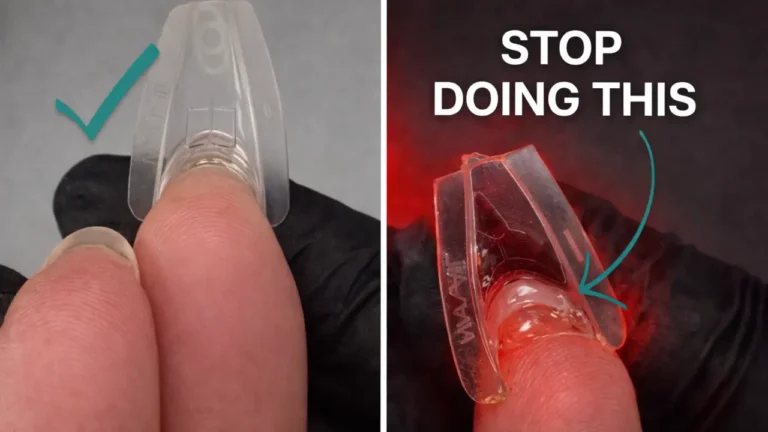
- the form is applied to the prepared natural nail;
- once the form is removed, the colour sits on the upper surface of the extension.
You may also see terms such as dual form inlay, reverse dual form technique or pre-polished extension. These terms are used for similar approaches, although terminology varies between educators and brands, so they should not automatically be treated as identical methods.
Why Does the Dual Form Colour Technique Look So Clean?
The inside of the dual form creates the upper surface of the nail. In a standard dual form application, that surface is usually refined and then coloured afterwards. With the dual form colour technique, the colour is already underneath the form, so the surface that is revealed on removal is both the architecture and the finish.
This is why there is so little need for top filing or refinement. The cuticle area in particular can look very neat, because the colour line is created against the smooth inner surface of the form rather than painted freehand close to the proximal nail fold.
The result can look highly polished immediately after form removal. That is the appeal of the method, and it is also the reason it needs careful planning: whatever the form creates is very close to what the client will wear.
My First Attempt With Colour Inside Dual Forms
This was my first time trying the dual form colour technique. I prepared the natural nails with Russian Manicure and pre-measured the dual forms before application.
I used Semilac One Step Dark Red as the colour inside the forms and polymerised it before placing the builder gel. For the building product, I used builder gel in a bottle. I also used fibreglass for additional support around the growth points.
When the forms were removed, the result looked very clean. The cuticle area was particularly neat, and very little refinement was needed on the upper surface. The finished set was one I genuinely liked visually. What happened afterwards is what makes this attempt useful to learn from.
Why Length Planning Matters More Than It Seems
I measured the intended length before application, but I had not fully accounted for how far the dual form would sit underneath the cuticle fold after Russian Manicure. Once the form was pressed into position, it moved slightly further under the proximal nail fold than I had planned for.
That small shift changed where the coloured section finished. On some nails, the colour coverage ended up too short, and I had to correct the free edge afterwards.
The professional lesson is straightforward: with the dual form colour technique, the technician needs to plan the colour length based on the final position of the form on the nail, not only on how the form looks before placement. A few millimetres of movement under the cuticle fold changes the visible result.
Why Form Selection Matters in the Dual Form Colour Technique
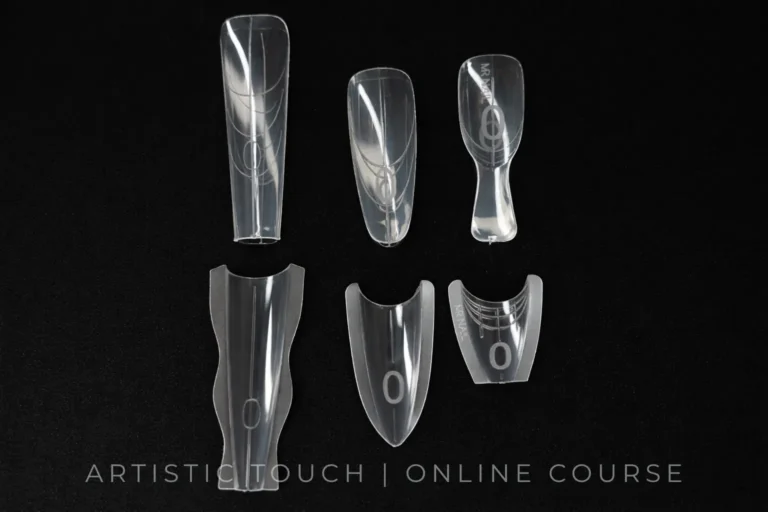
Because very little top correction is possible, the internal shape of the dual form has a direct influence on the final architecture. In a standard application, some imperfections can be refined away. With colour inside the form, filing the upper surface would remove the colour, so the form has to be right from the start.
A dual form that looks suitable from above may still create an unsuitable internal structure. The curve, depth and thickness it allows for determine where product sits, and therefore how much support the extension has at the stress area and free edge.
Different natural nails also require different form choices. The same form will not create the same architecture on a flat nail, a curved nail and a hooked nail. Having seen the result of this set, I would consider testing the method again using a form that creates more internal structure.
The Form Decides More Than the Finish
Choosing the right form, adapting it to the natural nail and understanding how it controls internal structure are the decisions underneath every clean dual form result. They are covered in detail in the Ultimate Dual Forms online course.
The Structural Problem I Found After the Set
I loved the finished appearance of this set. Over the following period, however, some of the free edges started to feel too flexible, and I broke two nails.
This made me question whether the internal structure created by that particular combination of dual form and product was sufficient. The surface looked correct, but the flexibility suggested that the architecture underneath may not have been providing enough support.
This is my observation from this particular set and this particular form and product combination. It does not mean the technique itself does not work, and it does not mean every dual form colour technique set will break. It does mean that the clean finish should not be taken as proof that the structure is right.
The Lesson From This Set
A beautiful result does not automatically mean the structure underneath is correct.
Why Polymerisation Needs Extra Attention
When colour is placed inside the dual form, it changes how much of the product underneath can be visually assessed during application. Opaque or highly pigmented colour makes it more difficult to judge what is happening beneath it.
Product thickness matters, because thicker layers of pigmented product behave differently under a lamp than thin, clear layers. Lamp compatibility also matters, as not every product is designed to be polymerised by every lamp.
The manufacturer’s instructions for each product must be followed, and the technician needs to understand polymerisation before using this technique. There is no universal curing time that applies to every colour, builder gel, form and lamp combination, and repeating a cure is not a guarantee that polymerisation is complete.
Why the Cuticle Zone Must Stay Thin
A thick cuticle area creates a visible ridge as the nail grows out. With the dual form colour technique, the form needs to sit cleanly against the prepared natural nail so that the product thins out towards the proximal nail fold.
Controlled product placement inside the form is what makes this possible. The method should not create unnecessary bulk around the proximal area simply because the colour line looks neat on removal.
Why the Underside Still Needs Refinement
Minimal top filing does not mean zero finishing. The underside of the extension may still need smoothing, and the free edge may still need shaping.
The aim is to smooth and refine without removing necessary architecture. Structure that has been built into the extension should not be filed away from underneath just to make the nail look thinner.
Can This Technique Be Used on Hooked Nails?
One of the nails in this set was a hooked nail, and it showed clearly that the natural nail shape changes how product distributes inside the form.
A hooked nail may need a different structural approach from the other fingers. At shorter lengths, some nails can look thicker because more product is concentrated in certain areas. The same form, and the same product distribution, should not simply be copied onto every finger.
Is the Dual Form Colour Technique Suitable for Beginners?
No. This specific technique requires a strong understanding of:
- dual form selection;
- product distribution;
- internal structure;
- polymerisation;
- cuticle preparation;
- underside refinement.
Without that understanding, the clean surface can hide problems that only become visible later, when the client is already wearing the set.
What I Would Change If I Tried It Again
- Consider a dual form that creates more internal structure.
- Plan the colour length more carefully, based on the final position of the form under the cuticle fold.
- Assess free-edge strength before judging whether the set was a success.
- Continue testing the technique rather than drawing a conclusion from one set.
I have also started thinking about another way of creating a similar colour effect, but I have not tested it enough to share yet.
What Nail Technicians Should Assess Before Using the Dual Form Colour Technique
- Form fit on the specific natural nail.
- Final form position after it is pressed under the cuticle fold.
- Colour length relative to that final position.
- Internal architecture created by the form.
- Product distribution inside the form.
- Free-edge support.
- Growth-point support.
- Polymerisation of both colour and builder gel.
- Cuticle-zone thickness.
- Underside refinement without removing structure.
Key Takeaway
The dual form colour technique can create a very clean surface, but the visual result is only one part of the outcome. Copying the visible steps is not enough. The decisions underneath, form selection, final form position, internal structure and polymerisation, are what determine whether that clean surface is supported by a nail that performs.
Plan the Structure Before You Plan the Finish
Learn how to choose the right dual form, adapt it to the natural nail, control internal structure and product distribution, and plan the finished result before application, so the clean surface is backed by the right architecture and less refinement is needed afterwards.
About Radina Ignatova and Her Teaching Philosophy
About the Author

Radina Ignatova
Professional Nail Expert since 2014 and International Nail Educator
I am Radina Ignatova, a Professional Nail Expert since 2014 and International Nail Educator, based in Scotland, UK. I am the Founder of Artistic Touch Nail Training Academy and TheNailWiki.
At Artistic Touch Nail Training Academy, I provide professional online nail courses specialising in dual forms, gel systems, polygel application, advanced nail structure, E-File work and Russian Manicure, with a strong focus on professional salon safety. I continue to work actively in salon practice, ensuring that all education reflects real client scenarios and current industry standards.
My teaching philosophy is simple: I show real salon challenges, real mistakes and real performance testing, not just perfect demonstrations. This is how you develop genuine technical competence and become a confident, capable nail professional.
Frequently Asked Questions
What is the dual form colour technique?
It is a method where colour is applied and polymerised inside the dual form before builder gel is placed. When the form is removed, the colour is already part of the upper surface of the extension.
Can you put gel polish inside dual forms?
Yes. In my first attempt, I used Semilac One Step Dark Red inside the dual form and polymerised it before placing builder gel. The product must be suitable for the lamp being used and applied according to the manufacturer’s instructions.
What is dual form inlay?
Dual form inlay is a term used for similar approaches where colour or design is placed inside the dual form before the building product, so it appears on the upper surface after form removal. Terminology varies between educators.
What is a reverse dual form colour technique?
It is another name used for applying colour inside the form first, in reverse of the usual order where colour is applied on top of the finished extension.
Do you need to file the top after using the colour technique?
Very little top refinement is usually needed, because the form creates the upper surface. The underside and free edge may still need smoothing and shaping, without removing necessary structure.
Why can colour inside dual forms look so smooth?
The colour is created against the smooth inner surface of the form, so on removal the surface and the colour are revealed together, without freehand application or top filing.
Can the technique be used with builder gel in a bottle?
Yes. I used builder gel in a bottle in my first attempt. Whether the finished extension has enough internal structure depends on the product and dual form combination, not only on the technique.
Can the technique be used with BIAB?
BIAB-style builder gels belong to the same builder-gel-in-a-bottle category. The same principles apply: form selection, product distribution, internal structure and complete polymerisation.
Why can a dual form colour technique set still break?
A clean surface does not guarantee sufficient internal structure. In my set, some free edges felt too flexible and two nails broke, which made me question whether that form and product combination created enough support.
Is the dual form colour technique safe?
It depends on correct application and complete polymerisation. Coloured or opaque product inside the form makes assessment more difficult, so manufacturer instructions, product thickness and lamp compatibility need careful attention.
Is it suitable for beginners?
No. It requires a strong understanding of dual form selection, product distribution, internal structure, polymerisation, cuticle preparation and underside refinement.
Why does dual form selection matter?
The internal shape of the form determines the final architecture, and very little can be corrected on top afterwards. A form that looks suitable from above may still create an unsuitable internal structure for that natural nail.
Want to understand the decisions underneath the technique, not just copy the steps? Explore professional online nail courses →
⚠️ Disclaimer
This article is for educational purposes only and is intended for trained nail professionals.
The dual form colour technique requires a strong understanding of dual form selection, product thickness, internal structure and polymerisation. Coloured or opaque gel products can make it more difficult to assess what is happening underneath the form during application.
Always follow the manufacturer’s instructions for product use, curing times and lamp compatibility. Incorrect application or incomplete polymerisation may increase the risk of irritation and acrylate allergy.
This article reflects my own first-hand experience with the specific products, dual forms and application shown. It should not be interpreted as proof that the technique itself will always produce the same result.
About Artistic Touch Nail Training Academy
Artistic Touch Nail Training Academy delivers professional online nail education focused on practical skill development, professional standards and safe salon practice. All courses are available online worldwide with lifetime access.